
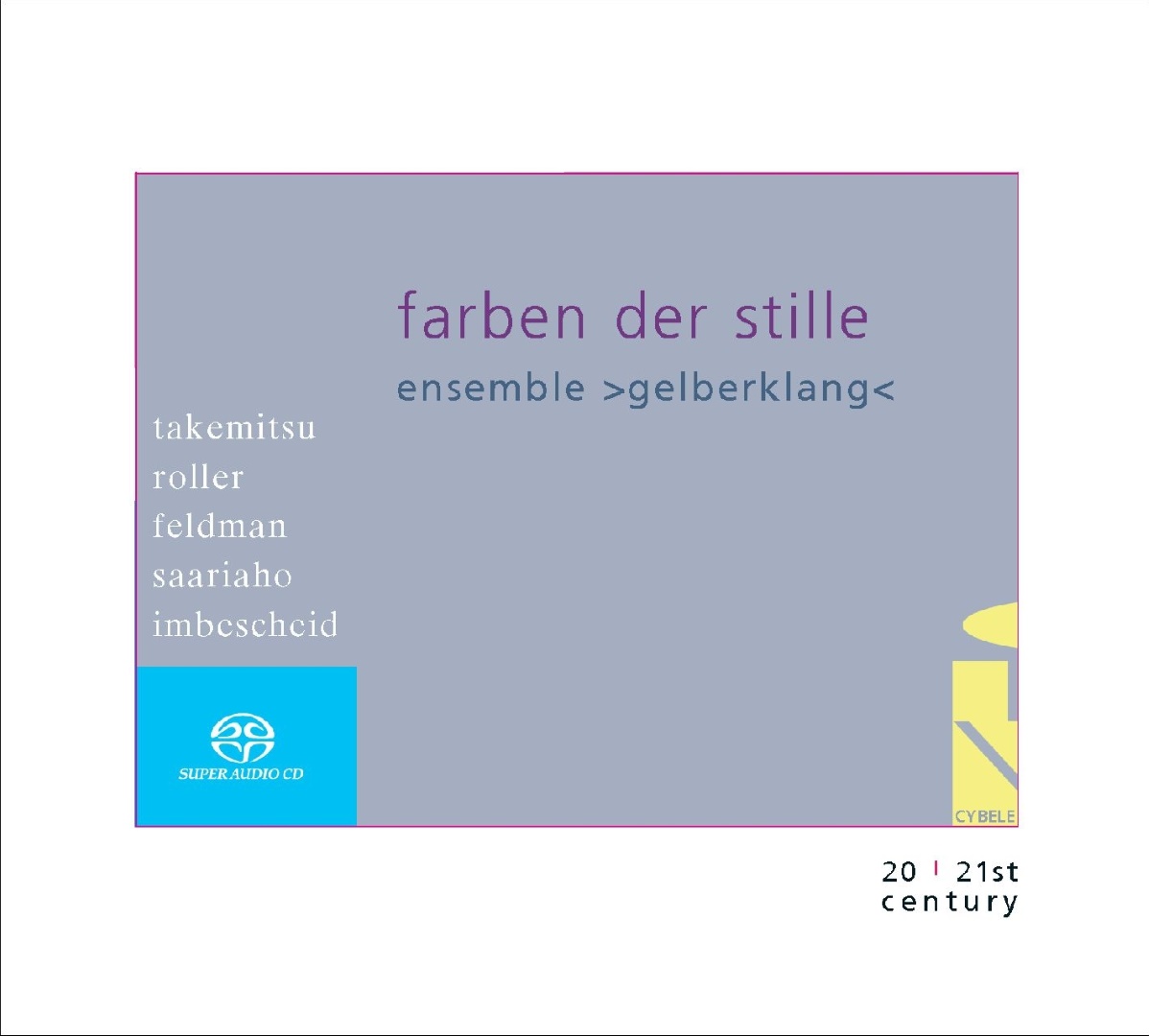
If music could be described through colours, white would probably be the commonest, Stefan Fricke writes in the booklet. In Concerning the Spiritual in Art of 1910 Wassily Kandinsky called white the symbol of a world from which no sound reaches us: it acts upon our psyche as a great silence, sounding inwardly like a non-sound — “a silence that is not dead but full of possibilities”. That is exactly what this programme is about: the suspension of the border between sound and silence.
In traditional Japanese aesthetics this understanding of music as part of silence is called “Ma”. The composed note does not compete with silence but enlivens it and draws attention to its everyday existence — “Ma o ikasu”, to enliven the Ma. For Toru Takemitsu this idea was central. His Rain Spell of 1982 belongs to the Waterscape group of works begun in 1974, whose common theme is water: independent pieces passing through different metamorphoses, as water circulates in the universe. Every component has the same value; there is no hierarchy of sound events, and the piece is continuously in flux.
In the West this notion spread above all through John Cage, especially since 4′33″ of 1952 — prompted among other things by Robert Rauschenberg’s White Paintings. The cellist and composer Scott Roller (1959–2024) was so fascinated by Richard Serra’s monumental iron sculptures that one of his works bears the sculptor’s name. A few months later came the violin-and-cello duo Serraval, named after a French village that struck him as archaic — the closeness to the sculptor’s name will have played its part in the choice. The six miniatures carry character markings that speak for themselves: dancingly coquettish, racing with centrifugal force, elegiac and grateful, fencing and brisk, stormy and insistent, narrating and reflective.
Dedication titles naming a person were originally an invention of Morton Feldman, in whose output many pieces since the sixties bear the names of friends among artists, musicians and writers. For Frank O’Hara of 1973 was first called In Memory of My Feelings; O’Hara, one of the important New York writers of the fifties and sixties and a close friend of the composer, had died in 1966 at the age of forty from the consequences of a car accident. Of his piece Feldman said laconically that his primary concern was to maintain a smooth surface with a minimum of contrast.
For Nymphea (Jardin Secret III) of 1987 Kaija Saariaho drew on Claude Monet’s water lily paintings: on the symmetrical structure of the plant, which floating on the waves bends and transforms itself, and on all that cannot be seen in it but only surmised. The live electronics extend the string quartet sound with fine shadings; towards the end the players whisper a melancholy poem by the Russian poet Arseny Tarkovsky into the microphone. Albrecht Imbescheid’s Farben der Stille, finally, consists of six parts of which only the last bears a title — Epilogue — and plays with the forms silence can take: as inward contemplation, as the expression of a speechless recognition, as a counter-model to the ubiquitous noise of our society. The Ensemble gelberklang, devoted to contemporary chamber music from 1992 and named after Kandinsky’s theatre project Der gelbe Klang of 1912, recorded the programme from 2 to 6 November 2002 in the Theater an der Halle in Ostfildern-Nellingen.