
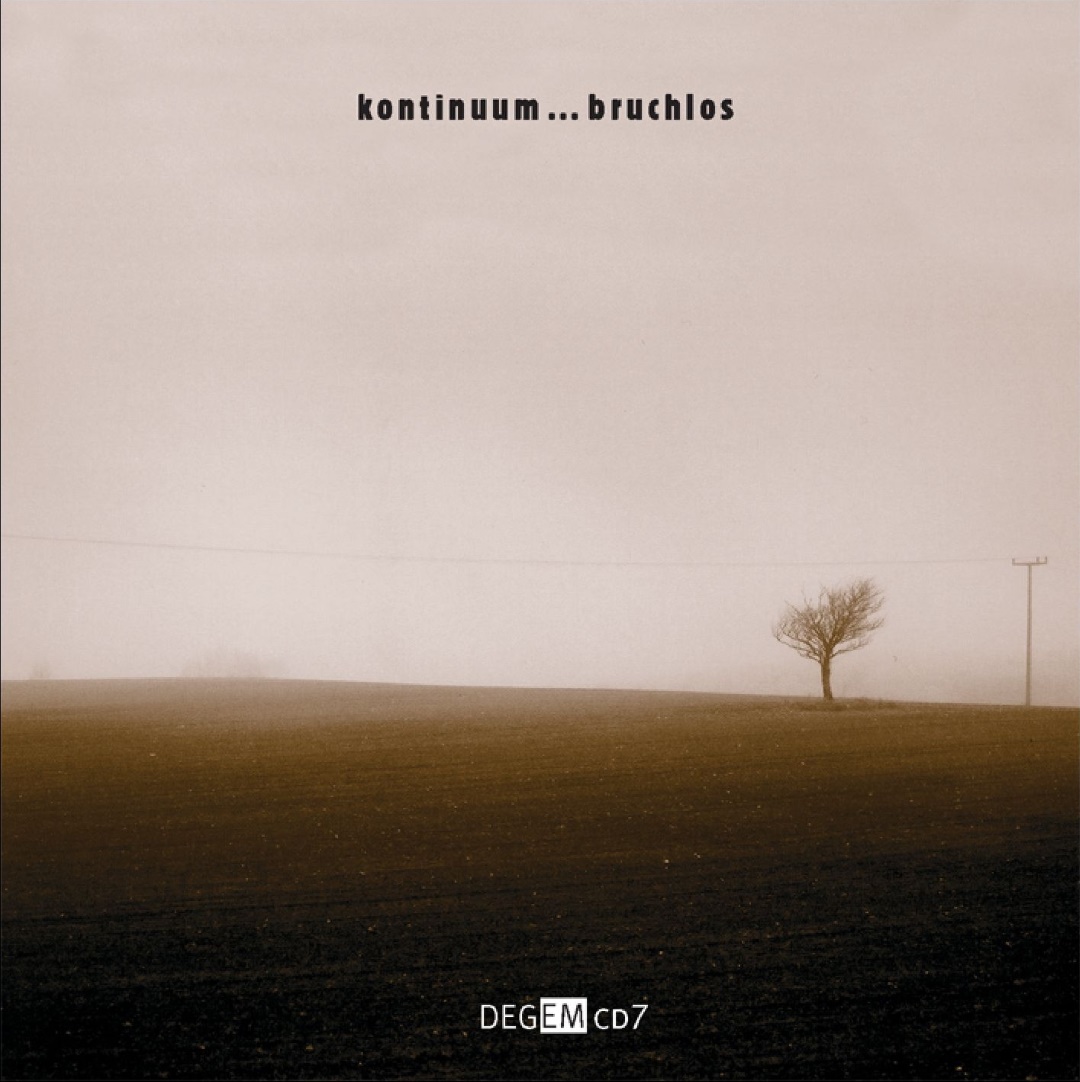
DEGEM, founded in Berlin in 1991 as the German section of the Confédération Internationale de Musique Electroacoustique, publishes recordings as well as writings; the works on its seventh CD were selected by Elena Ungeheuer. Javier Alejandro Garavaglia’s “OVERTURE (in memoriam T.A.T.)” (1997) for tape is a memorial to his viola teacher, who died in 1994. Garavaglia made C, the lowest note of the viola, the centre of the pitch system and derived two overtone series from it: a positive one standing for life and an inverted, negative one for its absence. Numerical references to the teacher’s name and date of birth organise rhythms and pitches algorithmically.
Hans Mittendorf-Labiche’s “Invisible Worlds” (1999) combines instruments, electronics and dance. The tape was created on the UPIC computer at Iannis Xenakis’s Ateliers UPIC in Paris, a system on which sounds can be drawn and played back in real time via a graphical interface; Clara Novakova (flute), Carol Robinson (clarinet) and Thierry Miroglio (percussion) play with live electronics, and the dancer was Isaura Corlay. The recording comes from the premiere on 19 May 1999 at the Centre Multimédia de l’ADAC in Paris during the Journées d’Informatique Musicale. Sven-Ingo Koch calls “saxl” (1999) a “window composition”: three saxophone samples, a swelling single note, a texture of key noises and a small moving group of notes, merge into one another through granular synthesis and phase vocoding, not in a linear way but cut into contrasting phases.
The initials in Harry-Ed Roland’s “N.A.M.A: ‘booty!’ don’t walk” (1999) stand for “(not) all men are …”, an allusion to Lincoln’s Gettysburg Address and Martin Luther King’s “I have a dream”. Roland sees the piece as his version of those truths “we hold to be self-evident”, written from the mornings on which he awakens in his dark skin: a piece about the creation of inequality and the irrational fears bound up with it, compositionally an etude on a single musical element. Werner Cee’s “Cities’ Drift (excerpt)” (2001) comes from “Drift”, a radio piece for the Hessischer Rundfunk. Cee broke down choral music from the repertoire of the choir Kamer into short samples, assembled them into new sound images and had the choir sing these in various rooms; descriptions of landscapes from Vincent van Gogh’s letters and names of cities from the Amnesty International yearbook served as prompts for improvisation. The piece was composed directly in the studio, in the spirit of musique concrète.
Karl Friedrich Gerber calls “Stream” (2000) computer-assisted improvisation: his program generates a stream of number sequences in real time, controlled by 18 formulae that he edits on screen; since the parameters are integers, he compares the method to Xenakis’s sieve theory. Frank Niehusmann’s “Arbeit” (2000) takes up DJ culture, but with two reel-to-reel tape recorders instead of turntables: prepared sounds are copied, partly with scratching, onto a three-metre eight-track tape loop that is playing back at the same time. Friedhelm H. Hartmann’s “Electric Symphony (Fugue)” (2000), the finale of a four-movement cycle, is based solely on the striking and ticking of a mechanical wall clock. Finally, in “Felix Regula IV” (2000), realised in Liège at the Centre de Recherches et de Formation Musicales de Wallonie, Roberto Doati breaks open the virelai “Sus une fontayne” by Johannes Ciconia, who spent his last years in Padua, where Doati lives; the instruments mirror one another and, at the same time, computer technology.