
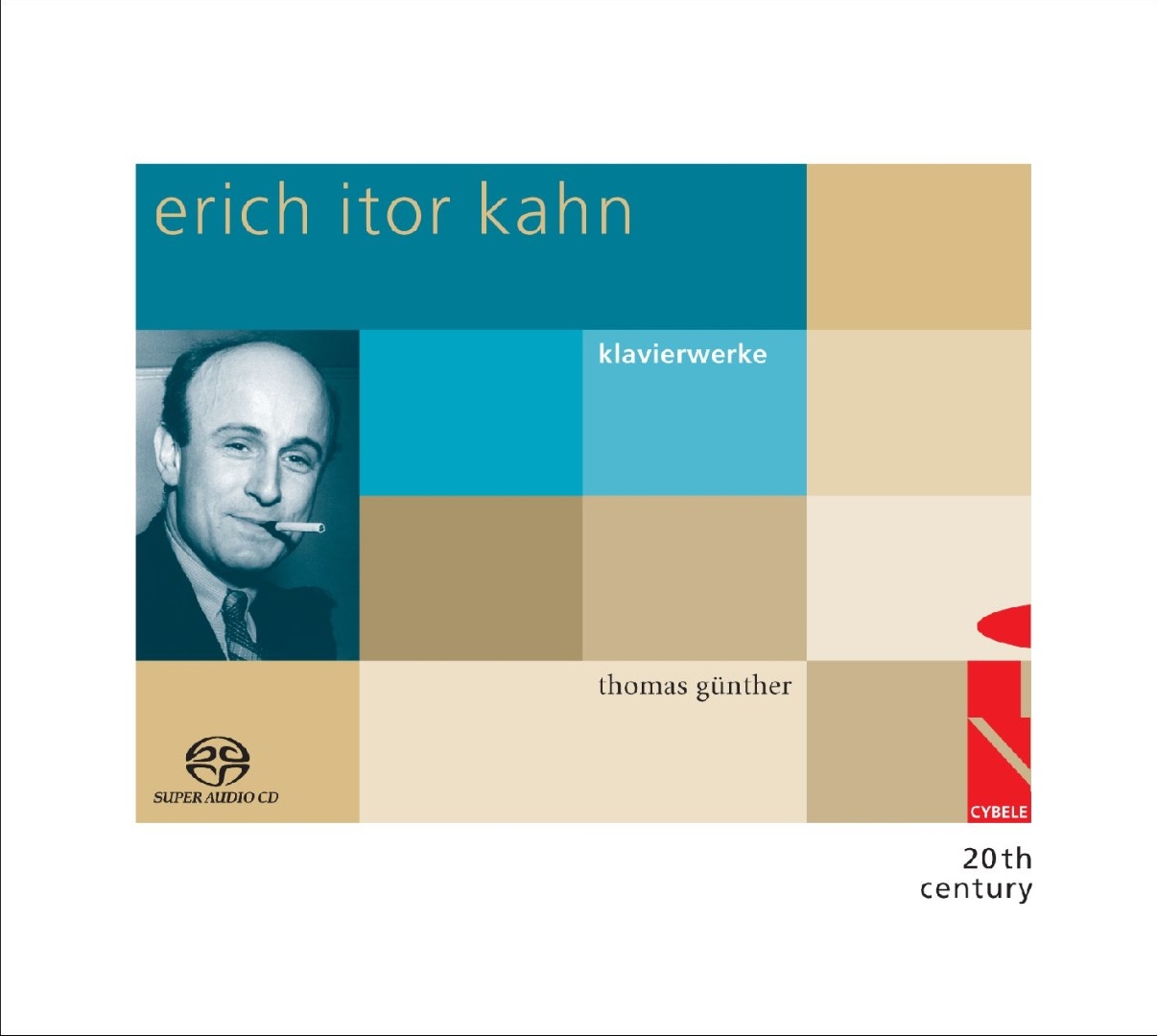
Erich Itor Kahn was born on 23 July 1905 in Rimbach in the Odenwald and studied piano with Paul Franzen and composition with Waldemar von Bausznern and Bernhard Sekles at the Hoch Conservatory in Frankfurt. In 1928 Hans Rosbaud brought him to Frankfurt radio, where on 29 January 1930 Kahn gave the first performance of Arnold Schönberg’s Klavierstück Op. 33a. Dismissed in 1933, he went to Paris and there introduced René Leibowitz to twelve-tone technique, which Leibowitz in turn passed on to Pierre Boulez. After fourteen months in French internment camps he reached New York in 1941, founded the Albeneri Trio there with Alexander Schneider and Benar Heifetz, and died on 5 March 1956.
Thomas Günther came across Kahn’s music in 1987, when Juan Allende-Blin asked him to play the Huit inventions pour piano at a concert in Düsseldorf devoted to works from the year 1937. In the booklet he describes a style poised between Schönberg’s twelve-tone technique in its most complex form and a polyphony whose density at times recalls Bach’s “Art of Fugue”. The Six Bagatelles Op. 5 of 1938 were intended for players who were not yet far advanced, yet technically they go far beyond Schönberg’s Klavierstücke Op. 19; the Berceuse senza re, for instance, does without the note D altogether.
The Huit inventions pour piano of 1937 pay homage to Johann Sebastian Bach. Sur un thème de Brahms takes up a motif from the Adagio of Brahms’s Horn Trio Op. 40, while the last piece, Sur une berceuse populaire allemande, derives all of its material from the lullaby “Schlaf, Kindlein, schlaf”. The Ciaccona dei tempi di guerra, Kahn’s longest piano work, was written in 1943 at the suggestion of Ralph Kirkpatrick and originally intended for harpsichord: 40 variations over a twelve-tone row in the bass, intensified with every contrapuntal device. Kahn deliberately introduces tonal allusions, and in the stretta Günther hears something close to bebop.
The Short piano piece, dated 31 January 1951, is Kahn’s last piano piece. Günther considers the Five Bagatelles for Piano, whose title refers to Beethoven’s Bagatelles Op. 126, to be Kahn’s most advanced piano works: from the Bagatelle for Erich Schmid, his only piece in three-part scherzo form, to the radical Bagatelle à René Leibowitz. Allende-Blin found the last two pieces in Kahn’s estate in New York at the end of the 1980s; Günther gave their first performance on 13 October 1989 at the symposium “Besuch aus dem Exil” in Essen. The last is unfinished.
Thomas Günther, professor of piano at the Folkwang Hochschule in Essen at the time of the recording, has devoted himself not only to the classical repertoire but above all to the Russian Futurists and to the piano music of the German-Jewish generation in exile and of the Schönberg circle. The recording was made in May 2006 at the Erholungshaus of Bayer AG in Leverkusen, supported by the Kunststiftung NRW and in association with the Kunstring Folkwang at the Museum Folkwang, Essen; klassik.com recommended it.