
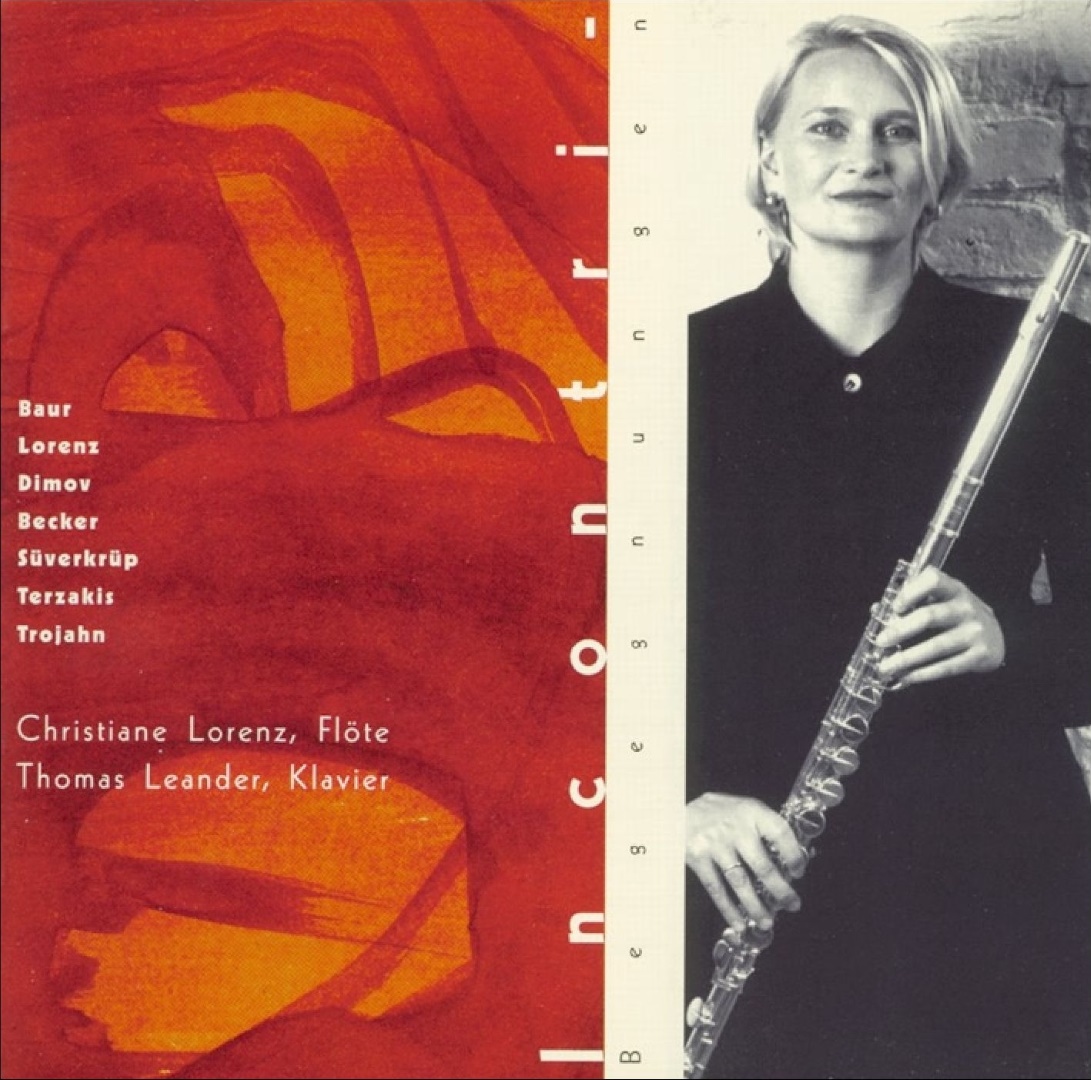
Encounters between two instruments, between several generations of composers, between the western and eastern European musical traditions: the wide circle this programme draws has a fixable centre. All the works recorded here for the first time are by composers connected with Düsseldorf — whether as teachers at the Robert Schumann Hochschule, like Jürg Baur, Günther Becker, Manfred Trojahn, Bojidar Dimov and Dimitri Terzakis, or as freelance musicians in their home city, like Tom Lorenz and Ben Süverkrüp, who represent the younger generation here. Baur and Becker may be called founding fathers of Düsseldorf’s musical scene not only for their work as composers but for their importance as teachers; it was the flautist Christiane Lorenz’s long acquaintance with their works that prompted this programme.
Jürg Baur, born in Düsseldorf in 1918 and a master pupil of Philipp Jarnach at the Cologne Musikhochschule, taught from 1946 at the Robert-Schumann-Konservatorium in Düsseldorf, forerunner of today’s Hochschule; as rector of the Robert-Schumann-Institut he occupied a central position in the city’s musical life from 1965 to 1972, and in 1971 he was appointed to Cologne as Bernd Alois Zimmermann’s successor. His three Incontri of 1960 are an outstanding example of a musical language indebted to tradition yet speaking with a voice entirely its own. Günther Becker’s Three Inventions of 1957 take up the task of developing a dense formal structure out of a single voice: through developing variation — the three-bar theme, formed from an extended twelve-note row, returns at once in a wholly new rhythmic shape — and through contrapuntal techniques such as inversion, together with a plastic melodic line of widely stretched intervals and a dynamic range from triple piano to triple forte.
Tom Lorenz, born in Düsseldorf in 1959, studied percussion and piano at the conservatory of his home city, specialised in the vibraphone from 1982 and explores in his work the border regions between jazz and the avant-garde, improvisation and experiment. Wadi for solo flute was written in July 1999 and is recorded here as a world première. The title is the Arabic word for a dry valley in desert and steppe regions, marked by absolute barrenness, yet where traces can be found of rare rainfalls that turn into torrents. The composition is about the wind blowing through such a valley, about the fissured valley flanks that produce different sounds according to how the wind strikes them, and it explores the minimal fluctuations within a bone-dry riverbed. Dryness as a state of being in between two rainy seasons becomes an emblem of a time between a past that seems chiselled in stone and a future of which it is not even known whether it will take place at all.
Bojidar Dimov, born in 1935 in Lom, Bulgaria, the son of an actor, studied composition and piano in Sofia and Vienna and attended the Darmstadt summer courses; from 1968 he lived in Cologne, where he founded the new music ensemble trial and error in 1970 and the Praktikum für Neue Musik at the Rheinische Musikschule in 1972. Ben Süverkrüp, born in Düsseldorf in 1967 and the son of the songwriter and painter Dieter Süverkrüp, studied composition with Wolfgang Hufschmidt at the Folkwang-Hochschule in Essen; a focus of his work is the engagement with history — his compositions respond to historical musical models, often to specific pieces, or deal directly with political history. His variations Ohne Blumen refer to variations by Franz Schubert and fall into theme, two scherzos, sonatina, fughetta and theme da capo.
Dimitri Terzakis’s Two Fairy Tales for solo flute circle around a single note in the first piece and, in the second, for large flute, around a central interval, the fifth G–D; both show the serial-chain form typical of him, but where the first intensifies towards a climax in its final section, the second arches back to its reflective opening. Manfred Trojahn, born in 1949 in Cremlingen near Brunswick, studied flute with Klaus Schochow and Karlheinz Zöller and composition with Diether de la Motte in Hamburg; he drew international attention in 1978 with first prize at the UNESCO International Rostrum of Composers in Paris, and in 1991 he took over Günther Becker’s composition class at the Robert Schumann Hochschule Düsseldorf. His virtuoso Objet trouvé of 1976, written for flute and harpsichord and authorised by the composer in the version with piano, begins with a violent, dry motion in which flute and piano throw aggressive peaks of sound at one another, and leads by way of softer figurative models into a restrained three-part counterpoint that the return of the opening theme abruptly ends. The recording was made from 11 to 14 October 1999 in the Erholungshaus of Bayer AG in Leverkusen.