
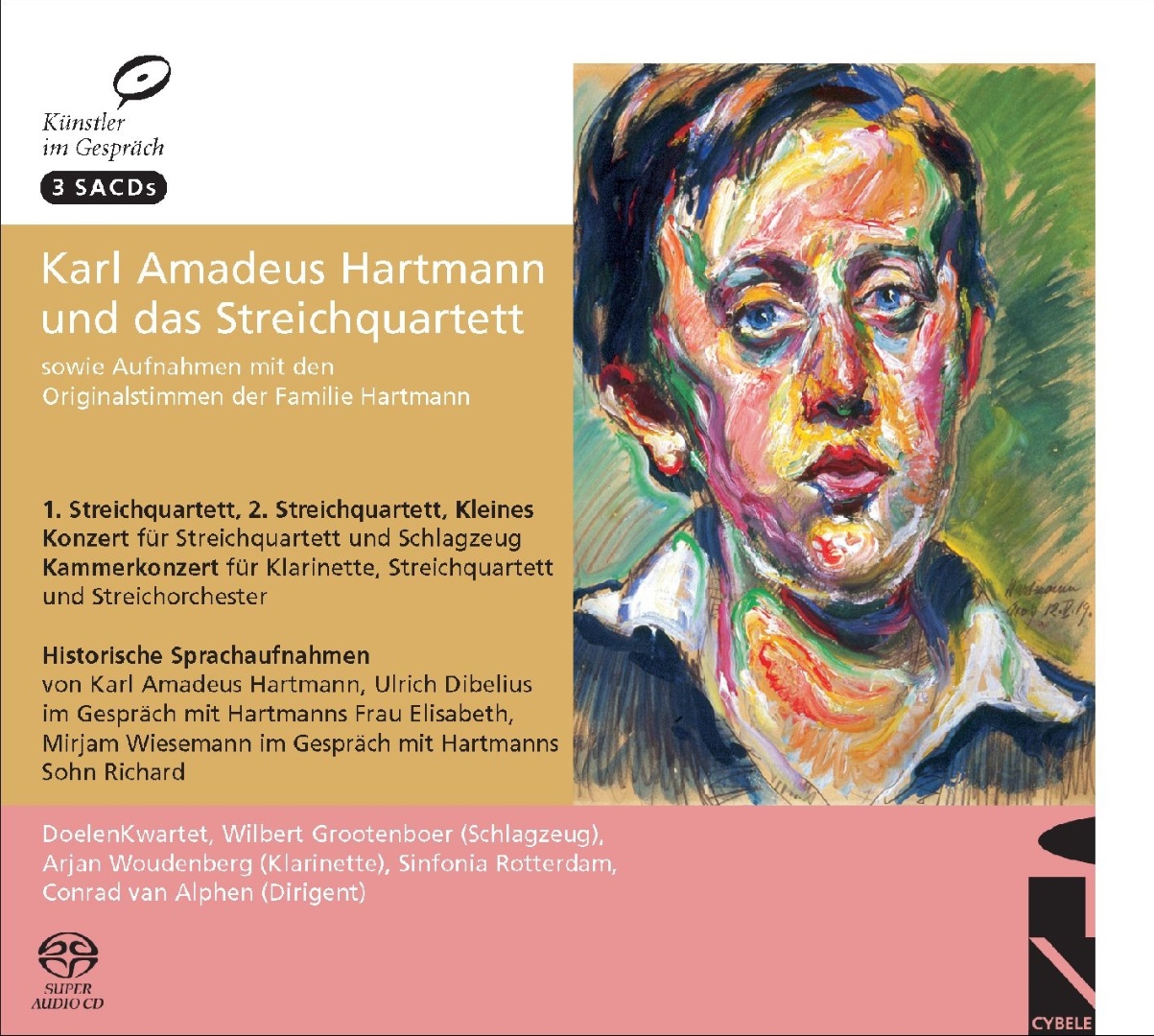
The edition “Künstler im Gespräch” (Artists in Conversation) aims, as Mirjam Wiesemann writes in the booklet, to open up access to the person behind the work of art: to the circumstances of his life, his family and the political situation of his time. It opens with Karl Amadeus Hartmann (1905-1963). After 1933 he renounced performances in Germany and withdrew into inner emigration; during the war he buried his manuscripts. In 1945 he founded the Musica Viva concert series in Munich, which he directed until his death.
Written shortly after 1933 and shortly after 1945, the two string quartets form, according to Hanns-Werner Heister, a kind of frame within Hartmann’s output. The String Quartet No. 1 “Carillon” (1933), dedicated to the conductor Hermann Scherchen, owes its nickname to a first prize awarded in 1936 by the Geneva chamber music society “Carillon”; the Jewish song “Elijahu ha-navi” opens the first movement as a fugato and returns in the finale. Hartmann wrote the String Quartet No. 2 (1945-48) for his wife Elisabeth, and the horror of the Nazi era and the war resounds in it. The second movement, a great instrumental lament, ends in E flat major; the Presto finale begins with a four-note gesture that could be sung to the name “E-li-sa-beth”, and the German note names F-E-G-H salute the Végh Quartet, which premiered both quartets.
Twice Hartmann integrated the string quartet into a larger ensemble; both works were premiered only after his death. In the Chamber Concerto (1930-1935), “written in the spirit, and in admiration, of Zoltan Kodaly”, the solo clarinet comes to the fore with virtuosity, and motifs from Kodaly’s Dances of Galanta, the workers’ song “Brüder, zur Sonne, zur Freiheit” and Jewish melismas intertwine. The Little Concerto (1931-32) for string quartet and percussion, released here on disc for the first time, filters echoes of march and circus music through Strawinsky’s techniques of alienation, for Heister a kind of musical fauvism; an Adagio with tender harmonics provides the counterweight.
Three sound documents complement the music. Around 1962, at the suggestion of Otto Tomek, Hartmann spoke about himself, about Arnold Schönberg, his Concerto funebre, opera, and art and politics; the tape recording appears here for the first time, restored and unabridged. In 1994 the music historian Ulrich Dibelius, a friend of the family, held a conversation of some eight hours with Elisabeth Hartmann, which he recorded privately on cassette; the selection ranges from the honeymoon through the war years to Hartmann’s death. Finally, on 31 July 2009, Hartmann’s son Richard P. Hartmann told Mirjam Wiesemann in his Munich flat about life with his father.
The DoelenKwartet, with Frank de Groot, Maartje Kraan, Karin Dolman and Hans Woudenberg, first encountered Hartmann’s music in the centenary year 2005 and for the quartets consulted Hartmann’s manuscripts in the Bayerische Staatsbibliothek as well as the Schott edition. It recorded the quartets in June 2009 in the Dorpskerk in Rhoon; the concertos with Wilbert Grootenboer (percussion), Arjan Woudenberg (clarinet), Sinfonia Rotterdam and Conrad van Alphen were recorded in April 2008 at De Doelen, Rotterdam, the Chamber Concerto live. In 2010 the album received the ECHO Klassik as surround recording of the year.